Perspective · Digital Skills and AI
The world’s education ministers gathered in Paris to debate how artificial intelligence should enter classrooms. For a country where two in three people are under 30, that is not an abstract question. It decides who gets the jobs of the next decade.
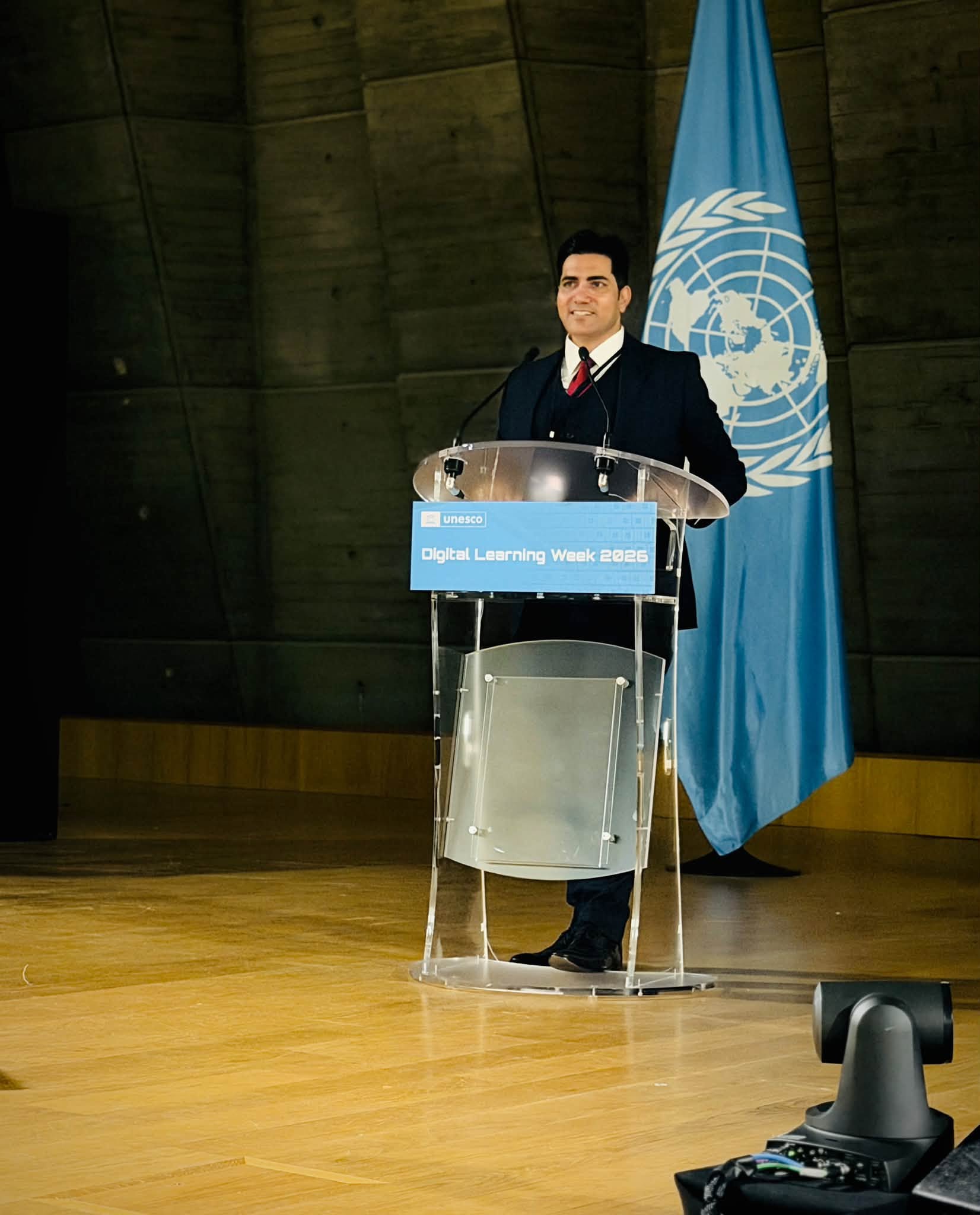
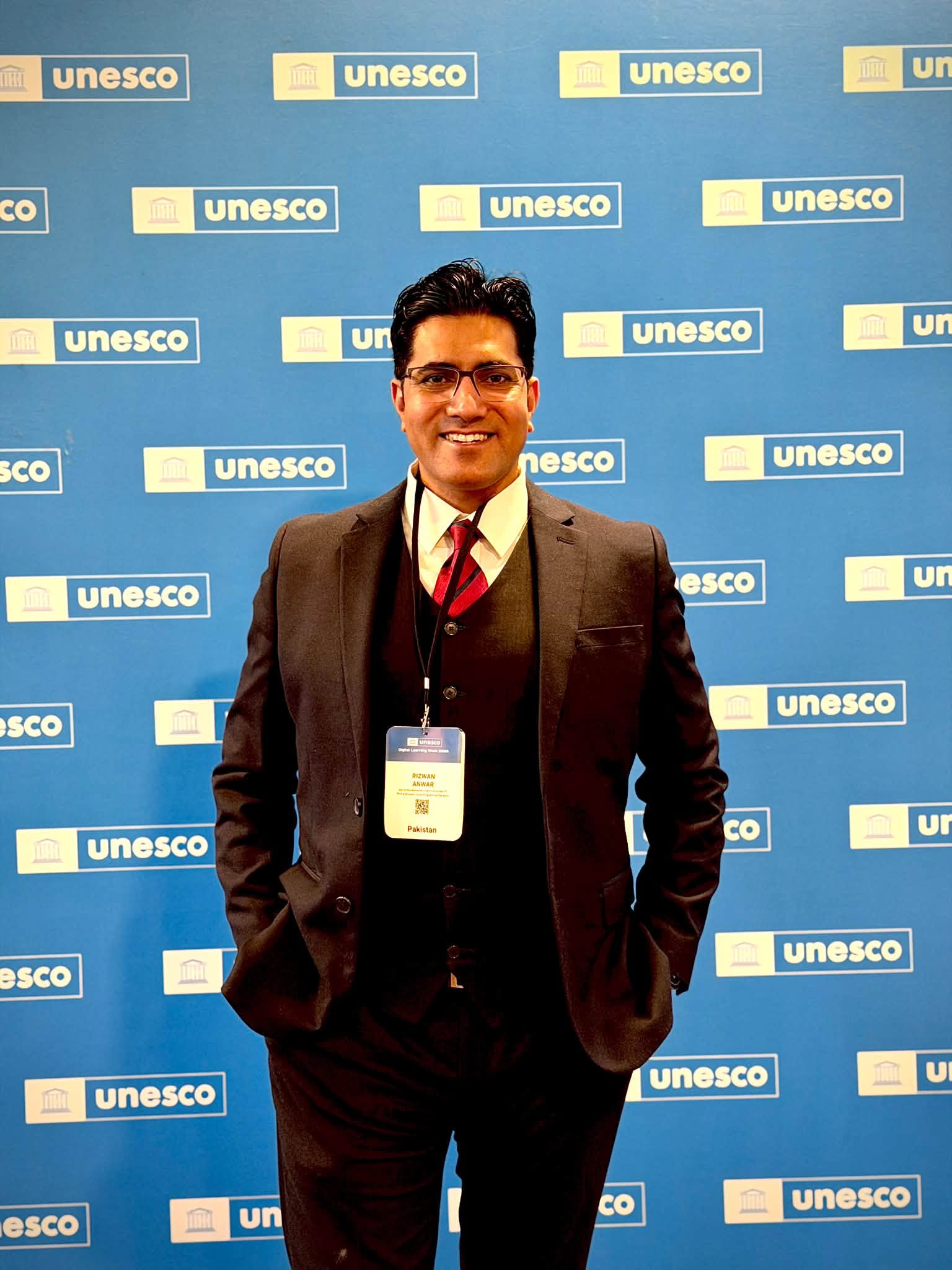
In September 2026 I represented the Prime Minister’s Youth Programme and the Prime Minister’s Youth Skills Development Programme, run by the National Vocational and Technical Training Commission (NAVTTC), at UNESCO Digital Learning Week at the organisation’s headquarters in Paris. Over four days, ministers, teachers, researchers and technology leaders debated a single, pressing question: how should education respond to artificial intelligence?
The discussions kept returning to an idea I brought home with me: digital transformation is ultimately about people, opportunity and inclusion. Technology changes what is possible. Whether it changes lives depends on who has the skills to use it, and who is left behind.
At a glance
- Event: UNESCO Digital Learning Week 2026, 8 to 11 September, UNESCO Headquarters, Paris (fourth edition, first held in 2023)
- Theme: Education in the Age of AI: Facts, Frictions, Frontiers
- Pakistan’s representation: Rizwan Anwar for the Prime Minister’s Youth Programme and NAVTTC’s Prime Minister’s Youth Skills Development Programme
- Focus: skills development, digital literacy and Pakistan’s digital and AI initiatives for young people
The global conversation: facts, frictions, frontiers
UNESCO has moved quickly from principle to practice on AI in education. It published global guidance on generative AI in education and research in 2023 and, a year later, competency frameworks setting out what students and teachers need to know about AI. This year’s theme captured the mood well. The facts are that AI tools are already in students’ hands. The frictions are real: unequal access, untrained teachers, unreliable outputs and questions about privacy and integrity. The frontiers are the new kinds of learning and work that AI makes possible for those prepared to use it.
My own conclusion from the week is that AI strategies rest on older foundations: trained teachers, reliable connectivity and basic digital literacy. Countries that skip those steps risk acquiring technology their education systems cannot yet use well.
Where Pakistan stands
Pakistan came to Paris with a substantial story to tell. The Prime Minister’s Youth Skills Development Programme has shifted a growing share of its training towards high-technology fields, including artificial intelligence, e-commerce and cyber security, and NAVTTC trained more than 100,000 people across its programmes in the 2025 financial year. The Prime Minister’s Digital Youth Hub, a single platform for youth opportunities, passed 800,000 registered users in June 2026. The government reports that 700,000 laptops have been distributed to talented students to date, with further Chromebooks planned, and under the new National Youth Employment Policy 1,000 young people are to be selected on merit for IT and AI training in China.
Three lessons for Pakistan
1. Digital literacy comes before AI fluency
It is tempting to leap straight to advanced AI courses. But a young person who cannot evaluate an online source, protect their data or use a spreadsheet will not benefit from a course on machine learning. The most effective programmes build a ladder: basic digital literacy for everyone, applied digital skills for work, and specialist AI training for those ready to climb further.
2. Teachers and trainers are the real bottleneck
Devices can be bought in bulk; capable instructors cannot. UNESCO’s decision to publish an AI competency framework specifically for teachers reflects a simple point: training the trainers has to come first. For Pakistan, scaling AI and digital skills depends as much on preparing teachers in schools, colleges and vocational institutes as on expanding the number of courses.
3. Inclusion has to be designed in
Left alone, technology tends to widen gaps. Pakistan’s own labour data show young women and graduates outside the major cities facing the steepest barriers to work, as I set out in my analysis of youth unemployment in Pakistan. Digital programmes reach these groups only if they are designed for them: online and blended delivery, women-only cohorts where needed, and training in local languages.

From policy to practice: what this looks like in Lahore
Global frameworks matter only when they reach a classroom. At the Centre for Digital Literacy & Business Management (CDLBM), a NAVTTC-registered institute at the University of Home Economics campus in Gulberg, Lahore, we are applying the same principles under our Skills for Tomorrow initiative: foundational digital literacy first, then practical business and AI skills that young people can turn into work or enterprise. It is one small example of how national programmes, institutions and international learning can connect.
Alongside the conference, I also met the United Kingdom’s Minister for Early Education and the British delegation; that discussion is covered in a separate report.
Conclusion
Pakistan’s young population is its greatest asset, but only if young people have the skills, knowledge and opportunities to compete in a global digital economy. The debate in Paris confirmed that the countries that succeed with AI will be those that treat it as a question of people rather than technology. That is the standard against which our own programmes should be judged: not how many devices or courses we provide, but how many young Pakistanis are able to learn, earn and lead because of them.
Sources
- UNESCO, Digital education and Digital Learning Week.
- Oman Observer, UNESCO meet explores education in AI age, 9 September 2026 (event theme).
- Associated Press of Pakistan, NAVTTC trains more than 100,000 students in different skills during FY 2025.
- Press Information Department, Digital Youth Hub passes 800,000 users, 23 June 2026.
- Radio Pakistan, PM launches first-ever National Youth Employment Policy, 12 August 2026.
- Press Information Department, Skills sector and NAVTTC a high priority of government (high-tech training focus).
Comments are closed